Azad Kashmir unrest grows amid economic struggles
Economic crisis sparks unrest in Azad Kashmir against Pakistan government
- By Gurmehar --
- Friday, 03 Oct, 2025
Protests in Pakistan-occupied Jammu and Kashmir (PoK) that began as demonstrations against rising electricity bills and high food prices have rapidly evolved into a full-scale challenge to the authority of the Pakistani state and the legitimacy of “Azad Kashmir.” What initially appeared as a localized economic grievance has now morphed into a broader political upheaval, questioning the long-standing narrative of semi-autonomous governance in the region.
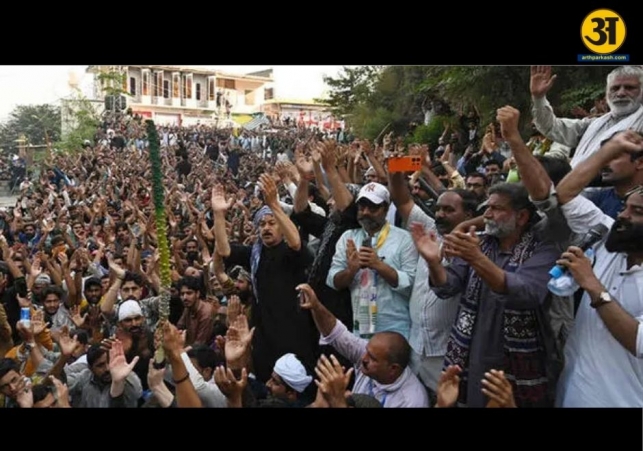
The unrest has been marked by violent clashes between protesters and security forces across multiple districts. Official reports indicate that at least 12 civilians have been killed and over 200 injured during confrontations in the last three days. The crackdown involved Pakistani Rangers and other security personnel, who have been accused of opening fire on demonstrators in Muzaffarabad and other areas. Tragically, three police personnel also lost their lives during the unrest, highlighting the intensity of the confrontations.
The protests, coordinated by the Jammu Kashmir Joint Awami Action Committee (JKJAAC), began on September 29 but quickly escalated beyond economic issues. Citizens took to the streets to voice their anger at soaring electricity tariffs, food inflation, and the rising cost of living. The sheer scale and intensity of the demonstrations indicate widespread dissatisfaction with Pakistan’s governance of PoK, a region long portrayed as “Azad” or free, yet heavily influenced and controlled by Islamabad.
From economic demands to political awakening
At the core of the movement lies a 38-point charter of demands presented by JKJAAC, which extends well beyond immediate economic relief. Protesters are calling for deep structural reforms, including slashing electricity tariffs, subsidising wheat flour, and ensuring free healthcare and education for all residents. They also demand the removal of elite perks and privileges that benefit a select few, reflecting frustration at systemic inequalities.
Another major demand is the abolition of 12 legislative seats reserved for Kashmiri refugees settled in Pakistan, seen as a relic of colonial-era governance imposed on PoK. These demands signal that the protests are no longer limited to economic grievances—they represent a broader political awakening, with citizens challenging the very legitimacy of “Azad Kashmir” under Pakistani oversight. JKJAAC leader Shaukat Nawaz Mir explicitly criticized the Pakistan government and army, stating, “Azad Kashmir is not free, but shackled by decades of exploitation and repression.”
Authorities have responded with a familiar set of measures to contain the unrest. Internet blackouts, communication restrictions, and road closures have been implemented to limit coordination among protesters and control the narrative. However, citizens have continued to defy these restrictions. Large march caravans have pressed forward through blockades to reach Muzaffarabad, demonstrating the determination and resilience of the movement. In Mirpur district, reports indicate that the body of a protester was not buried until certain demands were met, a symbolic act of resistance that underscores the depth of public anger.
The protests are significant not only for their scale but also for their message. For years, the concept of “Azad Kashmir” functioned as a nominal governance zone under Pakistani supervision, portrayed as semi-autonomous. But the current wave of unrest suggests that the population is no longer willing to accept superficial autonomy. The protests target Islamabad and the military establishment directly, undermining the official narrative of independent local governance.
The unrest spans across multiple districts, from Muzaffarabad and Mirpur to Neelum and beyond, indicating that dissatisfaction is not confined to isolated areas. Citizens are expressing frustration at decades of neglect, poor policies, and economic mismanagement that have left much of the population struggling to meet basic needs. The movement signals an emerging demand for accountability, political reform, and greater local control over governance and resources.
ALSO READ: RSS completes 100 years of service and organisation
ALSO READ: Coffee on empty stomach? AIIMS doctor warns against these coffee habits
Analysts suggest that the uprising may mark a turning point for “Azad Kashmir.” While past protests in PoK were often contained quickly and framed as economic complaints, the current demonstrations are broader in scope and political in nature. By challenging both Islamabad and the military, the citizens of PoK are pushing for a more meaningful form of autonomy and recognition of their rights. The protests demonstrate that economic desperation can rapidly evolve into political mobilisation when citizens perceive systemic neglect and repression.
The implications of the unrest are profound. For the Pakistan government, the protests highlight the fragility of its authority in PoK and the limitations of enforcing control through security crackdowns alone. For the people of the region, the movement represents a chance to assert their voice and demand structural changes that could redefine the political landscape of “Azad Kashmir.” The scale, coordination, and intensity of these protests suggest that any meaningful resolution will require both economic relief and genuine political reform.
In conclusion, what began as protests over utility bills and food prices in PoK has escalated into a broader challenge to Pakistan’s governance and the political fiction of “Azad Kashmir.” Citizens are no longer content with nominal autonomy; they demand structural change, economic relief, and political accountability. The government’s heavy-handed response, including internet blackouts and road blockades, has not quelled the movement, highlighting the depth of frustration. The protests indicate a growing political consciousness in PoK, where economic grievances and systemic neglect have transformed into a rebellion that questions decades of Pakistani authority. The coming weeks will be critical in determining whether Islamabad responds with reforms or faces continued unrest and political instability in the region.
Related News